
The artifact I chose is a commercial produced by Nike called “Dream Crazier.” It is a commercial that brings awareness for the perception of female athletes in sports. The commercial showcases the perception of female athletes being vastly different from the perception of male athletes. The author creates the character of a crazy woman in sports that every single female athlete can relate to. The commercial refers back to specific events women in sports have done and calls them crazy because that is how the world views it. As mentioned “How Does Rhetoric Work in Multimodal Projects” (2022) a rhetorical situation is a set of circumstances in which an author creates a text (Arola, Ball, Shepard 35). The rhetorical situation for “Dream Crazier” is to showcase female athletes and the negative connotations associated with their behaviors. A design choice I analyzed was the author’s emphasis on repeating the word “crazy.” The emphasis on the word “crazy” allows for the audience to view it in a positive connotation versus a negative connotation. The video lists great accomplishments of female athletes and defines them as “crazy.”
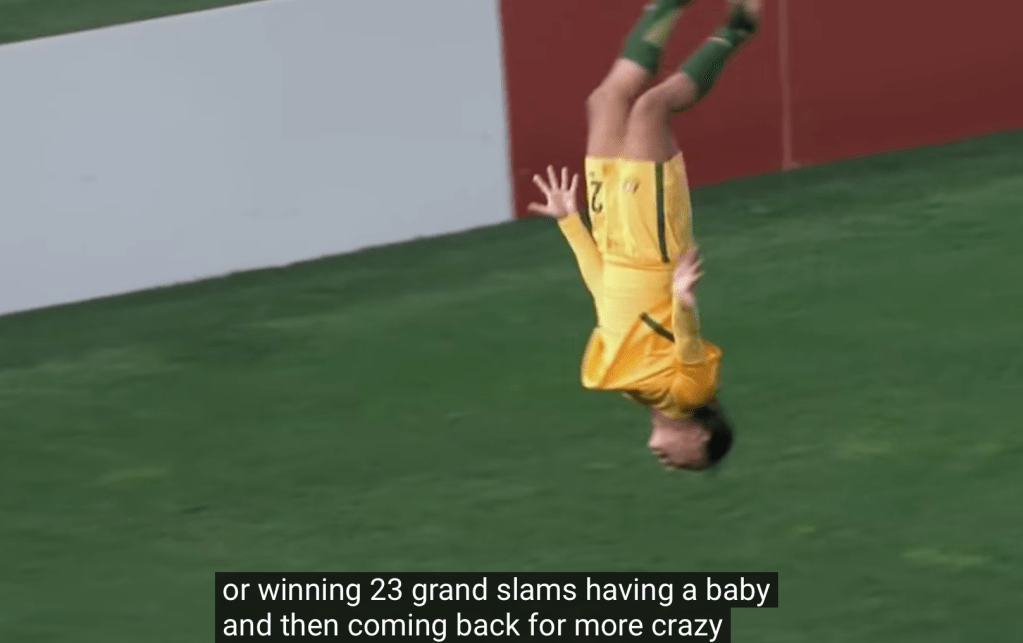
There are five modes of communication and “Dream Crazier” uses the linguistic mode which “refers to the alphabetic text or spoken word” (Gagich 68). Once again referring back the emphasis on word “crazy” allows for the spoken word to be powerful. The audience wants to hear each line the narrator says because it reveals another detail behind the video.
No matter the sport, anytime I watch a female athlete compete, it ignites a flame inside of me. I see myself in that athlete and it motivates me. Nike uses that same motivation in their commercial. A discourse community has “a broadly agreed upon set of common public goals”(Melzer 102). As mentioned before Nike under their discourse of female athletes wants to see equality in women’s sports.They understand that every female athlete has been called crazy at some point, and they focus in on that connection. To make the commercial relatable beyond female athletes, they emphasize being called crazy for completing a task in sports that some deem impossible. Most athletes can relate to being called crazy for trying to do something deemed impossible, not just female athletes. With that being said, the primary audience is female athletes or women in general. Female athletes and women can relate to the commercial the most because it is showcasing female athletes. In one part of the commercial it references Serena Williams having a baby, then coming back to her sport and this task is only something a woman can understand. The secondary audience is athletes, those who support equality for women in sports and sports fans. Athletes can watch this commercial and see themselves in these female athletes even if they are males. Nike wants all athletes to support this mission because it is something that highly impacts the world of sports. Another part of the secondary audience is those who support women equality because they are looking for ways to support women in our society to gain more equality in various spectrums. The final secondary audience is sports fans because they watch these athletes on their screens all the time and grow a level of personal attachment to them. The personal attachment to the athletes will make them more inclined to support the cause. The video is ultimately relatable to the audience because of the rhetoric tactics, rhetoric allows for people to search for meaning. As mentioned in “Rhetoric” “any time we are making meaning and interacting- otherwise known as being “human” we are using rhetoric” (Downs 6). The audience grows an. attachment to the video as they search for meaning in it, which makes it relatable them.
The message the commercial is displaying is that women need to keep pushing their boundaries in sports and it is okay to do so. People already assume a female athlete is crazy in certain situations so why not dream crazier too? There is an ideology that women are thought to be crazy when they do the same things as men such as getting mad at the ref, asking for a higher pay or growing frustrated after a loss, but for some reason when a woman does it it is completely different. Nike is encouraging women to challenge that ideology and dare to achieve more. They want young female athletes to see this commercial and feel inspired. In the commercial, it keeps referencing the line “dream crazier” because they want female athletes to see they can push the boundaries in sports.
An aspect of the commercial that made it stand out was the emotional appeal the video had. The narrator is giving negative examples of women being crazy in professional sports, which will enrage the audience and light a spark. The narrator slowly transitions into making the word “crazy” into a positive connotation that will inspire the audience. The narrator’s switch in meaning of crazy evokes an emotion with the audience that allows them to grow closer with the message. In the beginning when the narrator was explaining how being defined as crazy can be seen as negative I grew enraged because that has happened to me before. During one of my cross country races my shoe fell off within the first three seconds and I finished the race with one shoe. Everyone called me crazy, but it was the most fulfilling moment. As I watched the commercial I was able to relate to the multiple meanings of crazy and it evoked several emotions in me.
The artifact is composed of a series of clips placed into one video. The video showcases athletes as well as female coaches. The most prominent feature of this video is that each clip pulled actually happened in real life. The visual aid given to the audience is so powerful because they have most likely watched these clips in real time and now they are being pieced together to highlight the injustice in women’s sports. The inequalities being showcased in this video actually happened and there is no avoiding them. The genre of this commercial was a topical video, which focuses on a specific message and allows the audience to fully understand it.
“Dream Crazier” was initially released February 24th, 2019 and it was first aired during a commercial break for the Oscars. The commercial began being viewed on television, but it soon went viral via social media. Personally, I watched it during the Oscars and various times when it would come up on my Instagram, Twitter or Facebook. When it got released to social media it opened up the platform to even more critics. I remember men saying that the commercial was an overreaction to an issue that does not exist. Anytime a specific text makes it to social media it is going to face scrutiny and much more judgment than it would from various other platforms. The commercial’s spread through social media allowed for women all over the world to see it, which helped to further cultivate the message.
In the U.S. 2018 Open Serena Willaims got into an argument with the referee as she was attempting her twenty-fourth grand slam title. The referee made an awful call, and Serena was maddened by that. Her reaction brought up a variety of opinions from the public and she was being called “crazy” for her reaction. A year later, she narrated “Dream Crazier” and the clip of her U.S. Open 2018 match is in the commercial. The conversation that began from her match assisted in fueling the message of the commercial. The timing was perfect because more injustices in women’s sports were being noticed such as unequal pay. “Dream Crazier” gave a bigger platform for these discussions to be had.
Fair Use Statement: This digital text contains source material taken without the expressed consent of the original creators of the content. In accordance with Title 17 USC Section 107. I am using the sources incorporated in this space for educational purposes, not for commercial use.
Works Cited
Arola, K.L, Ball, C.E, Sheppard. J (2022). “How Does Rhetoric Work in Multimodal Projects.” Macmillan Learning, pp. 33-58
Downs, D.. “Rhetoric: Making Sense of Human Interaction and Mean-Making,” pp. 457-481.
Gagich, M. (2020). “An Introduction to and Strategies for Multimodal Composing.” Writing Spaces: Readings on Writing, South Carolina, pp. 65-85.
Kutz, E., Paster, D., Pulver, C. J. (2017). “Practicing Rhetoric in Digital Spaces.” Writing Moves: Composing in a Digital World, pp. 220-242.
“Nike – Dream Crazier | #Justdoit.” YouTube, YouTube, 11 Jan. 2020,
 Women in Sports
Leave a comment